
Recently, the research team led by Professors Sun Yueming and Dai Yunxi from our institute has made significant progress in the field of stability of nano-catalytic materials. The research results are titled "Dynamic Stabilization of Ultrafine Pt Nanoparticles against Sintering: Insights from Machine Learning (Dynamic Stability Mechanism of Anti-Sintering of Ultrafine Platinum Nanoparticles: Under the title of "From the Perspective of Machine Learning", this work innovatively proposed a "dynamic confinement" strategy and deeply integrated in-situ electron microscopy characterization with artificial intelligence analysis to visualize and quantitatively predict the anti-sintering behavior of catalytic materials at extreme high temperatures. It provides a brand-new theoretical framework and design paradigm for designing practical nanocatalizers with both high activity and ultra-long lifespan As a cover paper, it was published in the international journal Nano Letters.
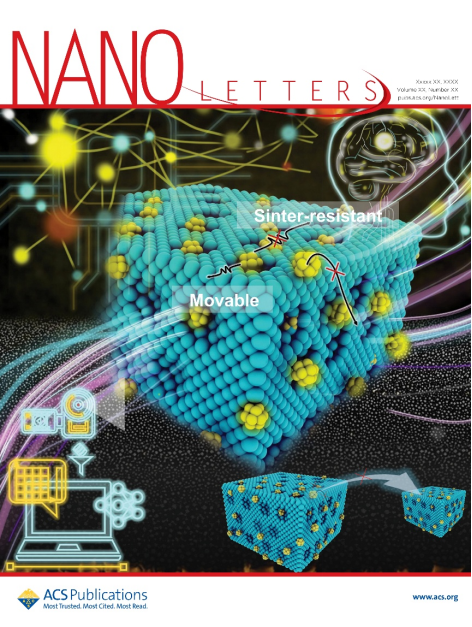
(图片来自Nano Letters)
In high-temperature heterogeneous catalysis, the agglomeration and deactivation of the active components of the catalyst due to "sintering" is the core bottleneck restricting its industrial application. Especially for ultrafine platinum (Pt) nanoparticles with a size less than 3 nm, their extremely high surface energy significantly reduces the Taman temperature. Metal atoms can migrate at a relatively low temperature, leading to rapid particle growth through migration merging (PMC) OR Ostwald ripening (OR) mechanisms. Therefore, how to achieve a fundamental breakthrough between high activity and thermodynamic stability is a major challenge that the field has long faced. In response to this challenge, the research team developed a dynamic confinement strategy. They anchored ultrafine platinum nanoparticles (<3 nm) on porous iron oxide (Fe2O3) carriers and utilized a Na2Ti3O7 nanowire skeleton to enhance overall thermal stability. In-situ transmission electron microscopy real-time observations have for the first time revealed that at extreme temperatures as high as 850 °C, platinum nanoparticles can remain mobile within the channels and edge regions of the carrier, but are effectively confined within specific nanospaces, thus achieving a unique state of "movable but non-aggregated" at the atomic scale and strongly inhibiting the occurrence of sintering. To deeply analyze and quantify this complex dynamic process, the team constructed an artificial neural network model. This model successfully established the quantitative structure-activity relationship between the microenvironment where the particles are located (such as the distance from the hole/edge) and the evolution of temperature and particle size. The prediction results are highly consistent with the experimental data (R² > 0.92). The model clearly indicates that channel confinement and edge confinement are the key structural factors that endow nanoparticles with outstanding anti-sintering ability, advancing the research on catalyst stability from phenomenon observation to a new stage of predictable quantification. Under harsh conditions close to practical applications, this catalyst has demonstrated extraordinary performance. Taking the oxidation of carbon monoxide as the model reaction, the catalyst aged at 500 °C can achieve complete conversion of CO at 150 °C. More prominently, after continuous operation at 175 °C for 600 hours, the activity of the catalyst did not decline. Even in the enhanced deactivation test that increases the reaction space velocity, its activity decay rate constant is extremely low, demonstrating its outstanding long-term working stability. This provides an effective solution to the industry problem of rapid sintering and deactivation of catalysts due to local overheating in strongly exothermic reactions. This work, through a full-chain research of "rational material design - in-situ microscopic mechanism - machine learning prediction - application performance verification", not only created a platinum-based catalyst with extreme anti-sintering performance, but also profoundly revealed the microscopic mechanism of dynamically confined stable nanoparticles, promoting the deep integration of artificial intelligence in the design and failure analysis of catalytic materials. Tang Mingyu, a doctoral student from the School of Chemistry and Chemical Engineering at Southeast University, is the first author of the paper, and Professor Dai Yunxi from our school is the corresponding author. Southeast University is the sole corresponding institution for the paper. This research was supported by the National Key Research and Development Program, the National Natural Science Foundation of China and other projects.