
Recently, Professor Zhang Chunyang's team from our college has made a significant breakthrough in the research of ultra-sensitive nucleic acid detection biosensors. The relevant achievements are based on "Synchronous 3D-DNA walking driven dual-color RNA aptamers lighting up for label-free and attomolar profiling" the title "multiple circRNAs in breast cancer" (Synchronous three-dimensional DNA walking Drive dual-color RNA aptamer Lighting Technology for label-free and amolar-level Precise Analysis of Multiple Circular Rnas in Breast Cancer) was published in the top international academic Journal "Journal of the In "American Chemical Society" This sensor has demonstrated excellent diagnostic accuracy in all clinical stages of breast cancer from the early stage to the advanced stage, providing an important technical platform for biomedical research and clinical diagnosis.
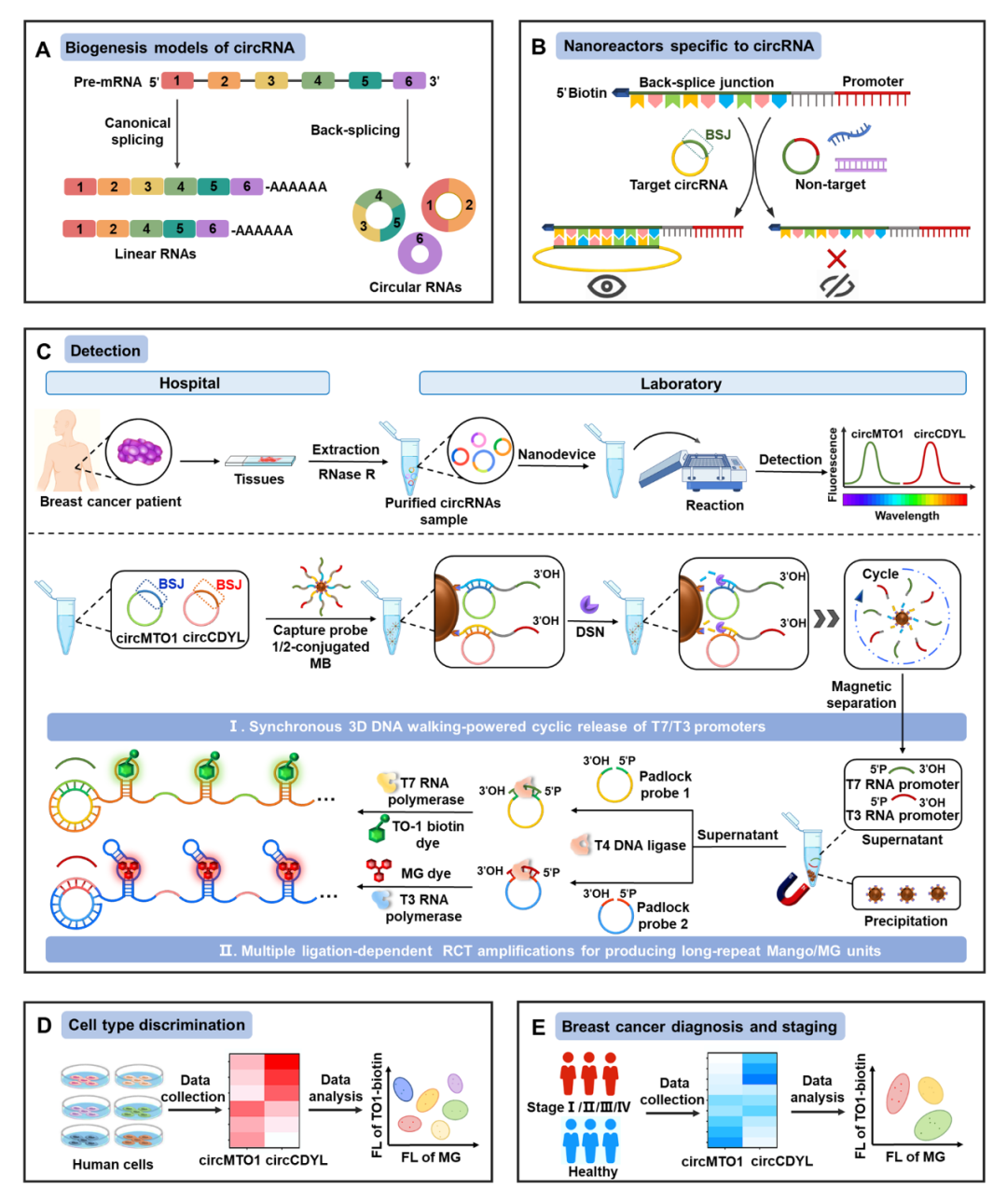
Circular RNA (circRNA) originates from the reverse splicing event of precursor RNA, forming a class of covalent-closed circular transcripts composed of exon or intron sequences, and plays a key role in the occurrence and development of tumors through multiple molecular mechanisms. However, due to the cross-species diversity and high sequence homology of circrnas, achieving precise detection of multiple circrnas still faces significant challenges. At present, the methods available for circRNA detection generally have problems such as low sensitivity, large sample consumption, slow reaction kinetics and complex primer design, which greatly limit their further application. Given that a single human disease often involves abnormal expression of multiple circrnas, developing a technology capable of quantitative detection of multiple circrnas is of great significance for improving diagnostic accuracy and guiding individualized treatment.
This study proposes a dual-color RNA aptamer lighting strategy based on synchronous three-dimensional DNA walking drive for label-free, amolecular ultrasensitive detection of various circular Rnas (circrnas) related to breast cancer. This nanosensor contains two pairs of specific capture probes and padlock probes. When the target circrnas (circMTO1 and circCDYL) are present, they can be hybridized with capture probes by recognizing their reverse splicing sites, initiating double-stranded specific endonuclease-driven three-dimensional DNA walking, and thereby triggering T7/T3 RNA polymerase-mediated rolling loop transcription amplification. Generate single-stranded RNA products containing repetitive sequences (i.e., Mango and MG aptamers). Subsequently, TO1-biotin and MG dye respectively bind to the corresponding aptamers, generating significantly enhanced bicolor fluorescence signals. The detection limits of this sensor for circMTO1 and circCDYL are as low as 10.96 aM and 17.78 aM respectively, and it can quantify the expression of circRNA in different cell types at the single-cell level, effectively distinguishing breast cancer cells from normal cells, as well as breast cancer tissues from healthy tissues. Importantly, it demonstrates high diagnostic accuracy across the entire spectrum of breast cancer clinical staging: 91.1% in the early stage (stages I-II) and 99.4% in the advanced stage (stages III-IV), providing a high-value analytical platform for biomedical research and clinical diagnosis.
The first author of this paper is Wang Shi, a doctoral student from our college. The co-corresponding authors are Professors Zhang Chunyang and Wang Lijuan from our college. Southeast University is the sole corresponding institution of this paper. This research was supported by the Jiangsu Province Frontier Leading Technology Basic Research Special Project and the National Natural Science Foundation of China General Program.